How do we protect our creativity at the start of term?
It doesn’t matter how many times you do it or how many INSET days you have. September just never eases anyone in. New classes full of new students, new staff members, new courses to complete online, new expectations to meet – a lot on everyone’s plate. There’s also an unspoken pressure to prove straight away that you can hit the ground running. The most frantic start of the school year gives way to timetables that seem to fill instantly. Homework starts. There's rarely a gentle on-ramp, and this is the same for students as well as teachers.
I'll admit my own September start hasn't exactly been serene either. My 1-year-old daughter has just started nursery, which means my days now run to the tightest of schedules. I love her dearly, but if you'd told me a year ago that negotiating a nappy and outfit change would be the most demanding part of my day, I would have laughed at you. Between that and a full teaching and tutoring timetable, time feels tighter than it has…well, possibly ever! Which is exactly why protecting a bit of creative thinking has started mattering more to me. When everyone's stretched thin, I think the easy option is to default to routines we know and cling on. The tried and tested formula that we know works. It’s the same for teachers in the classroom and it's just as true for stressed students.
At the busiest times when we are tired, creativity and time spent reading, planning lessons and evaluating the content of each lesson is one of the luxuries that is usually the first to go. But perhaps September is exactly when creative thinking needs the most defending.
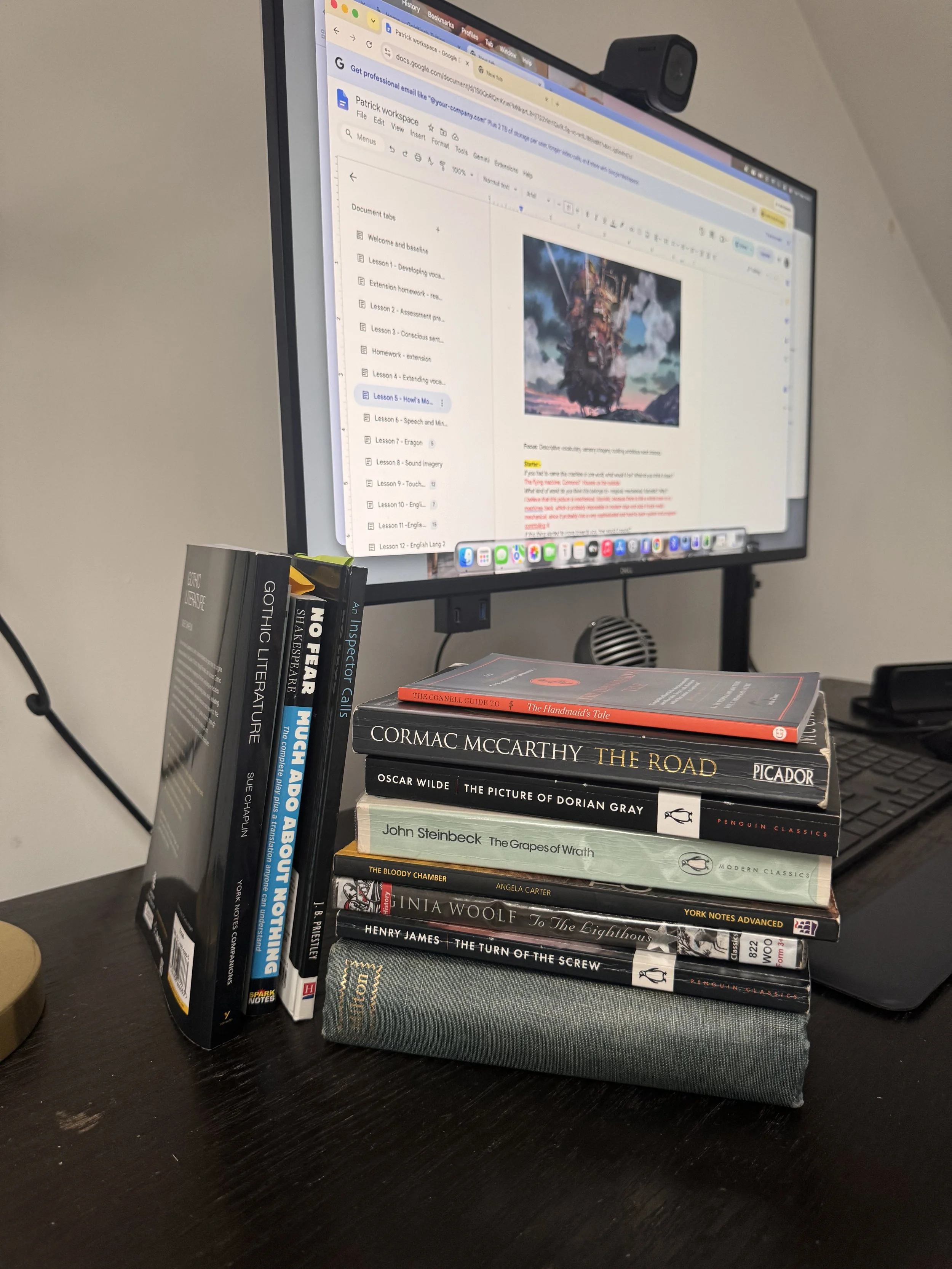
A Real Example:
Student A and Japanese Ghost Stories
I had a good reminder of this in a lesson with one of my students, student A, this week. Rather than starting straight into a familiar creative writing brief, I had the time to read widely and research the best source material. The student in question loves manga and I’ve had success with fantasy recommendations in the past. In the end, I selected the story ‘Jikininki,’ from a collection of classic Japanese ghost stories by Lafkadio Hearn. They had popped up as a recommendation while I was browsing a site, and I'd never actually sat down with them before. They're the kind of eerie, strange folk tales that don't get anywhere near a GCSE anthology. I was hooked! No formula, no assessment objective plastered across the top of the page. Just unfamiliar material and the question: what makes this unsettling, and how do we you build that same feeling? In the story we used, a wandering Zen priest, Muso Kokushi, gets lost in the mountains and is turned away from a hermit's hut for the night, then directed to a nearby village. There, he learns the headman has just died, and by local custom the whole village must leave the corpse unattended overnight, because strange things are said to happen in a house where a body is left alone. I won’t spoil the ending, but opportunities like this are sort of why I fell in love with tutoring – the freedom to incorporate any work of literature into a lesson.
The discussion and engagement was sharper than what we had produced in recent lessons. The new, weird material was engaging because he couldn't fall back on rehearsed technique. He had to notice how the tension was built, sentence by sentence, and then try it himself. That's the whole exercise in miniature: unfamiliar text, genuine noticing, personal response. It's a useful thing to build into the first weeks of term precisely because there's still time for it before the timetable tightens and every lesson becomes exam-shaped.
How might we build this in from the get-go?
Read outside the set text in a routine - even ten minutes a week, with no task attached beyond noticing something.
Offer written response before you analyse. Ask a student to attempt a scene in a writer's style – do this immediately before any analytical discussion.
Reward the unexpected interpretation. A slightly unconventional but well-argued reading is worth far more than a safe one.
None of this takes long, but we all know a gruelling school term has a way of consuming unstructured time whole. Protecting a little time to research texts, make lessons unique and bespoke to our classes while there's still room to breathe – that, for me represents the magic of teaching.
Looking for GCSE English tuition, A-level English tutoring, or IB English support that builds real analytical and creative skill rather than formulaic answers? Get in touch with Goldfinch Tuition to find out more about one-to-one online English tutoring, proudly serving the UK and Hong Kong.
